Ephemeris
One instrument. One light. One year.
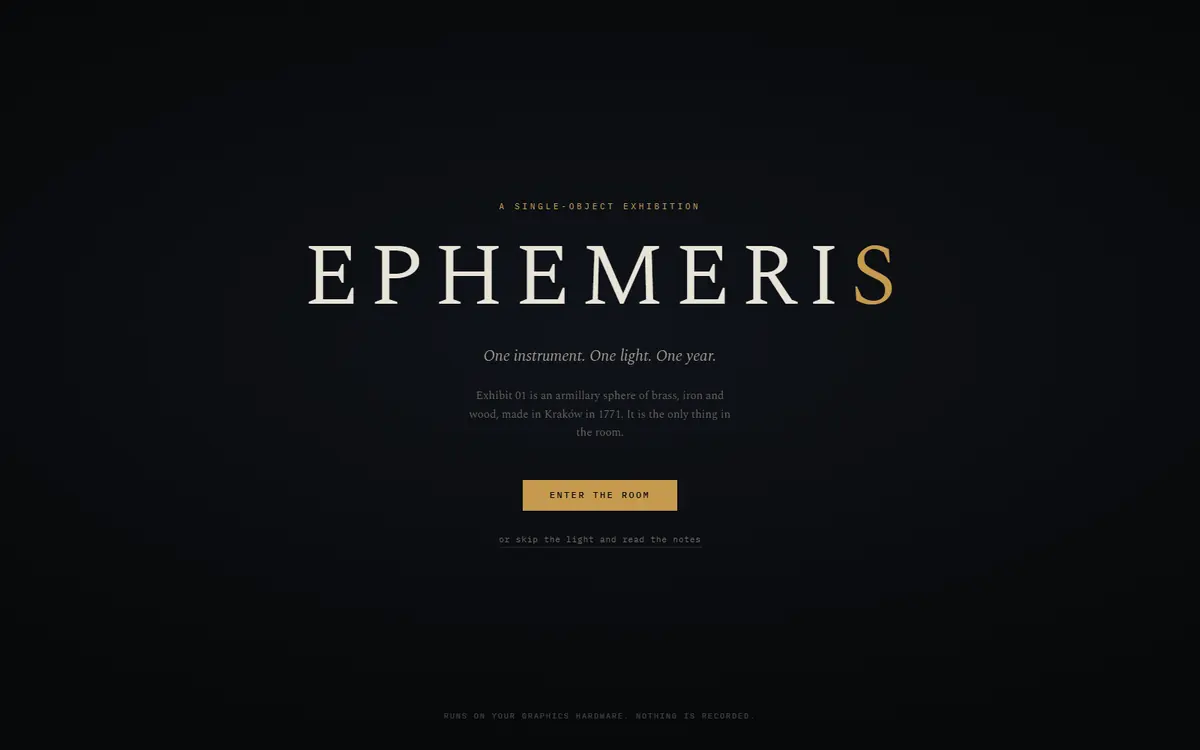 Fig. 11
Gallery / WebGL
Fig. 11
Gallery / WebGL
A gallery that shows exactly one object at a time. Exhibit 01 is a real armillary sphere made in Kraków in 1771, standing in an unlit room and read by one moving light.
Most of what is worth seeing on an old instrument is only visible when the light is nearly parallel to its surface. That conservation fact is the entire site.
-
A real object, and the licence is in the file.
The scan is the Jagiellonian University Museum’s 1771 armillary sphere by Franciszek Słupski, digitised for Virtual Museums of Małopolska and published on Zenodo under CC BY 4.0. The badge was not the evidence: the licence, author and source are asserted inside the delivered file itself, and the attribution is carried in the page footer, which is what CC BY requires.
-
The raking light is the exhibit.
The engraving on the horizon band is invisible under ordinary light and comes back at four degrees of incidence. In the third act the lamp is handed to the visitor. The relief comes out of the scan’s own normal map, so the marks that appear are the marks that are there.
CheckThe lamp is held about four degrees above the band, so flat brass stays dark while a groove wall tilted into the light reaches full brightness — six times the contrast with the field still dark.
-
Five acts, one scroll.
About eleven and a half viewports: the object at distance, a fall onto the horizon ring from above its plane, the raking light, the pull-back with the instrument turning, and the composition it is left in. Each act holds at a plateau; the notes underneath are plain readable text and are the whole site without JavaScript.
-
What the scan cannot do is not faked.
It is one fused solid: there are no separable rings in the file. So the fourth act does not pretend to articulate them. What turns is the whole instrument about its vertical axis, as a museum turntable would, and the orbital motion the piece is about lives in the light, which runs a 23.4-degree inclined arc around it throughout.
-
Springs, not lerps.
The camera position, its target and the scroll position are each a critically damped spring integrated on real elapsed time. A lerp’s speed depends on frame rate and has no momentum, so it cannot arrive at a plateau with weight; a spring arrives asymptotically, which is what makes a hold feel like a hold rather than a freeze.
-
One code path.
The renderer selects a WebGPU backend where one exists and WebGL2 where it does not, and the shader graphs compile to both from the same source. No dust motes, no light particles, no debris: one lit object in a dark room does not need company.
- Triangles
- 309kfour 1K PBR maps, Draco geometry
- File
- 5.90 → 2.26 MBthree texture maps re-encoded to WebP in place
- The lamp’s arc
- 23.4°inclined, running around the object throughout
- The walk
- ~11.5viewports, in five acts with holds